Cute Bunny Character Clipart Set
First Impressions: Playful, Clean, and Surprisingly Versatile
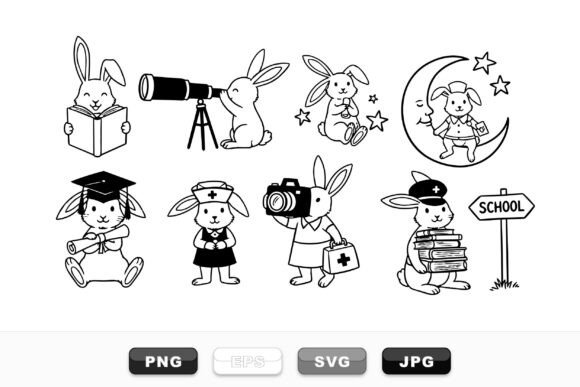
Opening the Cute Bunny Character Clipart Set, I immediately noticed how well its black-and-white line art breathes — not too tight, not too loose. These eight bunnies aren’t just “cute”; they’re intentionally expressive: a bunny adjusting glasses at a desk, another holding a vintage camera, one with a stethoscope peeking from a pocket. The educational theme feels warm, inclusive, and quietly clever — no forced whimsy, no visual clutter. As an embroidery designer who’s stitched hundreds of clipart-derived motifs, I appreciated the consistent stroke weight and open negative space. That matters. A lot. It means fewer stitch-density surprises, smoother satin-stitch transitions, and cleaner running-stitch outlines when scaled down.
A Real Project Test: Embroidering a Baby Shower Tote Bag
Last week, I used the “nurse bunny” design on a natural cotton canvas tote for a client’s baby shower gift. Why this set? Because softness + clarity = trust. Parents scanning handmade gifts respond to clean lines and gentle character — not overly busy or cartoonish silhouettes. I digitized the SVG into a 3.2" machine embroidery design, added light fill stitches in the ears and paws (keeping the rest as crisp outline), and ran it on medium-weight tear-away stabilizer. The result held up beautifully: no puckering, no thread breaks, and the bunny read clearly even from six feet away. Customers don’t buy “clipart” — they buy *recognition*, *intention*, and *care*. This set delivers that quietly.
Where It Shines (and Where It Needs Thought)
The Cute Bunny Character Clipart Set works especially well for:
- Custom apparel: Sweatshirt embroidery on fleece-lined hoodies — the bold outlines pop without bleeding;
- Embroidered patch production: clean edges mean sharp heat-transfer or sew-on results;
- Baby embroidery on onesies and burp cloths — minimal detail avoids snagging or irritation;
- Holiday embroidery like Easter tea towels or spring-themed pillow covers — it reads instantly but never feels dated;
- Etsy seller assets: use one bunny per listing thumbnail, pair with soft pastel mockups — it converts because it feels handmade, not mass-produced.
But be thoughtful with placement and fabric choice. On thin jersey or stretchy knits? Add cut-away stabilizer and reduce stitch density manually — those fine lines can distort if tension isn’t dialed in. On dark fabric? Stick to high-contrast thread colors (white, cream, or pale mint) and avoid tiny interior details — the “student bunny’s” pencil tip or “photographer bunny’s” camera dials may vanish unless you simplify them in your digitizing software. And skip curved surfaces like caps unless you’re using a low-profile hoop and reducing height — some poses have taller elements (like the nurse bunny’s upright posture) that don’t wrap cleanly.
What It Adds to Your Craft Business — Beyond the Stitch
This isn’t just another graphics download. As a small shop product or boutique branding element, the Cute Bunny Character Clipart Set elevates perceived value. Why? Because consistency reads as professionalism. Use the same bunny across a matching set — embroidered kitchen towel + baby bib + greeting card illustration — and customers subconsciously register cohesion. That builds trust. For Etsy sellers, it helps differentiate your listings from generic “bunny clipart” results. Buyers scroll fast; recognizable, friendly characters stop them. And for personalized gifts? That “photographer bunny” on a custom apron for a new mom who shoots film? It’s not decoration — it’s storytelling.
Practical Designer Notes Before You Stitch
Before turning this into a finished product, here’s what I do — every time:
- Test on scrap fabric first, especially if pairing with textured weaves (like linen-look tea towels) — line art can get lost in heavy grain;
- Check thread color contrast across both light and dark backgrounds — black-on-cream reads differently than white-on-navy;
- Review stitch density in any filled areas (e.g., ears or satchels); dense fills on lightweight fabric = stiffness and cracking over time;
- Confirm hoop size compatibility — while the original files are SVG and EP (likely embroidery-ready), always verify dimensions match your machine’s max hoop before stitching;
- Inspect small details under magnification: eyelashes, buttons, or text on props — they may need simplification for reliable embroidery;
- Use proper stabilizer — medium-weight cut-away for knits, tear-away for stable wovens, and fusible for layered items like quilted pillow covers;
- Confirm licensing — since this is a digital embroidery file intended for commercial use, double-check whether resale of finished products or digital derivatives (like printable mockups) is permitted;
- Try black-and-white mockups — it reveals balance and legibility faster than color previews.
Final Thought: Not Just Graphics — Design With Purpose
The Cute Bunny Character Clipart Set sits comfortably between craft and commerce. It’s not flashy — and that’s its strength. In a market flooded with overdesigned, overly saturated clipart, this set trusts the maker’s judgment and the customer’s eye. It supports handmade product integrity instead of competing with it. Whether you’re stitching a single personalized gift or building a cohesive line of nursery decor, these bunnies bring warmth without overwhelming. They work because they’re designed *for use*, not just display. As a designer who’s seen countless embroidery files fail under real-world conditions — fraying threads, muddled outlines, mismatched scale — I can say this plainly: the Cute Bunny Character Clipart Set earns its place in your embroidery project toolkit. Just remember: great clipart is only as strong as the intention behind it. Stitch thoughtfully.